Skyjo Score Sheet
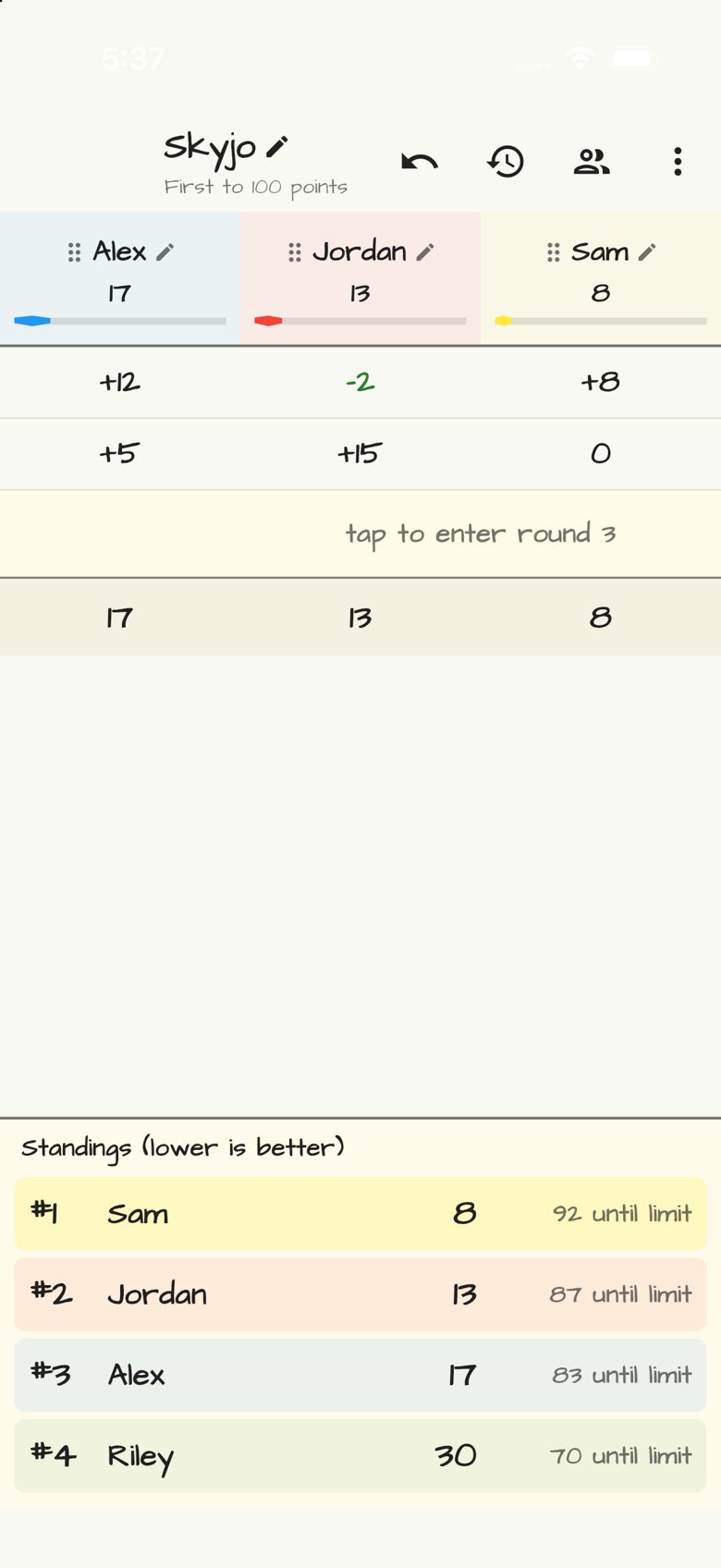
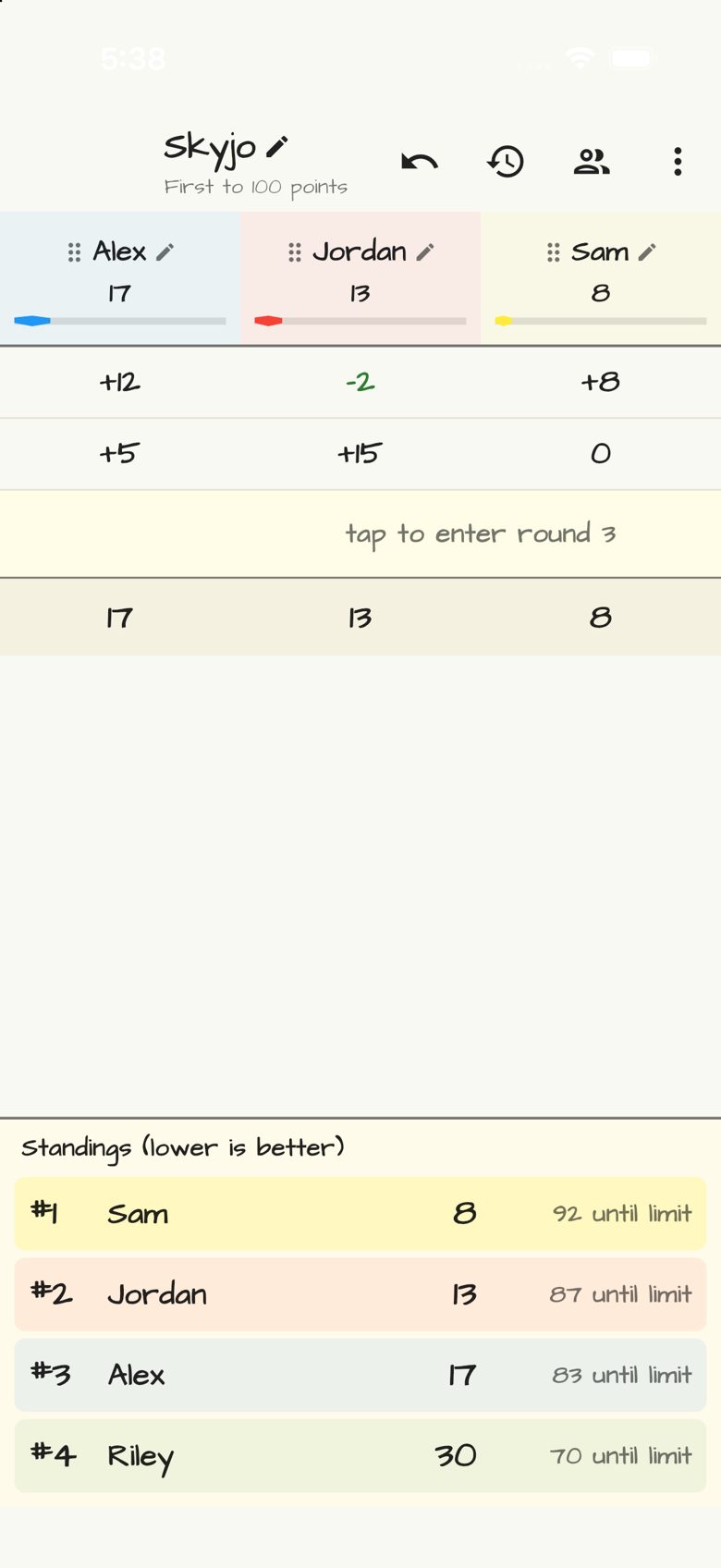
Card Dedicated scorecardA free Skyjo score sheet in Doodle Score.
Page challenge
Skyjo grid counter
Pick a value from the strip, then tap a card in the 3 × 4 grid to lay it there. Three matching cards in a column vanish. Leave face-down cards blank.
Clear a column for a gold star. Best: –
Loading…
Who goes first?
Settle it before the Skyjo argument starts. Pick how many players, add names if you like, and spin.
Keeping score too? Doodle Score remembers your players and tallies every round.
How to score
- Each player has a 12-card grid. Cards are −2 to 12. Keep the total low.
How to play
- On a turn, draw or take the discard, then swap it into your grid (or discard it and flip one card).
- Three of the same value in a column: that column is removed.
- When one player has all cards face up, everyone else gets one last turn, then add the grid.
Questions
Why did my score double? If you go out and you are not the lowest grid, your round total is doubled.
When is the game over? When someone reaches 100 after a round. Lowest cumulative total wins.
Set Up in Doodle Score
Skyjo has a dedicated scorecard in Doodle Score — everything is pre-configured including score tracking, validation, and special rules.
Download the app, tap New Scorecard, and choose Skyjo.
Game Identity
- Name: Skyjo
- Player Count: 2–8 players. Standard: 3–5.
- Teams: No teams. All players compete individually.
- Theme: Commercial card game by Magilano. Players manage a 12-card grid of face-down cards (values −2 to 12), swapping to minimize their grid total before someone goes out.
Scoring Mechanics
- Scoring Variant: Evasion — lowest cumulative score across rounds wins.
- Target Score: First player to reach 100 points triggers the final round. Lowest cumulative score wins.
- Unit of Scoring: Sum of visible card values per round (negative values are possible).
- Lower vs. Higher: Lower is better. Negative scores are good.
Rules & Validation
Card Values
- Card range: −2 to 12 (with card 0 also in the deck)
- Card distribution: The deck contains multiples of each value (e.g., more 0s and common values than extremes).
Per-Round Logic
- Setup: Each player is dealt 12 cards face-down in a 3×4 grid. Each player reveals 2 cards to start.
- On each turn: A player either draws from the deck or takes the top discard. They may replace any card in their grid (including face-down cards) — replaced cards go to the discard. Or they discard without swapping (only if taking from the deck).
- Columns: If a complete column of 3 cards shows the same value, those 3 cards are immediately removed from the grid and discarded (scoring 0 for that column).
- Going Out: A player "goes out" when all their cards are face-up. All other players get one final turn.
- Round Scoring: Each player sums the values of all remaining cards in their grid. The player who went out gets a penalty if their round total is NOT the lowest: their score is doubled for that round.
Validation Rules
- Per-player per-round score: sum of all grid card values (can be negative).
- If the player who went out doesn't have the lowest round score, enter double their actual total.
- Scores accumulate across rounds until someone reaches 100.
Special Actions / Bonuses
- Column Clear: Three matching values in a column disappear — net 0 for those cards.
- Going Out Penalty: Going out with a higher score than another player doubles your round score.
Win Conditions
- Condition: When any player's cumulative score reaches or exceeds 100, that round completes fully. The player with the lowest total wins.
- Tie-Breaker: If two players tie for lowest, play one additional round.
Common Skyjo rules questions
The arguments that come up at the table, answered from the official rules. Where house rules differ, we say so.
Do three in a row across count in Skyjo?
No. Only three matching face-up cards in one vertical column are removed. Horizontal rows don't count in classic Skyjo.
When does the finisher's score double?
If the player who ends the round doesn't have the single lowest score, a tie included, their round score doubles. Zero or negative scores are not doubled.
Can a column be removed after the last card is flipped?
Yes. If revealing your hidden cards at the end makes a matching column, remove it before you count.
Can you look at a face-down card before flipping it?
No. Face-down cards stay hidden until you flip them or swap them out. A swapped-out card goes face up on the discard pile.
Do three matching negative cards get removed too?
Yes. Any three matching face-up cards in a column are removed, even −1s or −2s, which means losing those negative points.