Cee-lo (4-5-6) Score Sheet
Dice Dedicated scorecardA free Cee-lo (4-5-6) score sheet in Doodle Score.
Page challenge
Beat the banker
Best of five. The banker rolls first, then you get up to three tries to make a result. 4-5-6 and any triple win, 1-2-3 loses, and a pair makes the odd die your point.
Win 3 rounds for a gold star. Best: –
Loading…
Who goes first?
Settle it before the Cee-lo (4-5-6) argument starts. Pick how many players, add names if you like, and spin.
Keeping score too? Doodle Score remembers your players and tallies every round.
How to score
- Three dice. Instant win: 4-5-6 or any triple. Instant loss: 1-2-3.
- A pair plus an odd die sets a point (the odd die, 2–6). 2 is the lowest point, 6 the highest.
- Banker rolls first. Everyone else tries to beat that point.
How to play
- Win, lose, or push. Play an agreed number of rounds.
Questions
What if I roll nothing — no pair, no 4-5-6? Reroll. Keep rolling until you get a result.
Is 4-5-6 better than a triple? Both are automatic wins against a point. Two automatic wins usually push. Agree if triples beat 4-5-6 at your table.
Set Up in Doodle Score
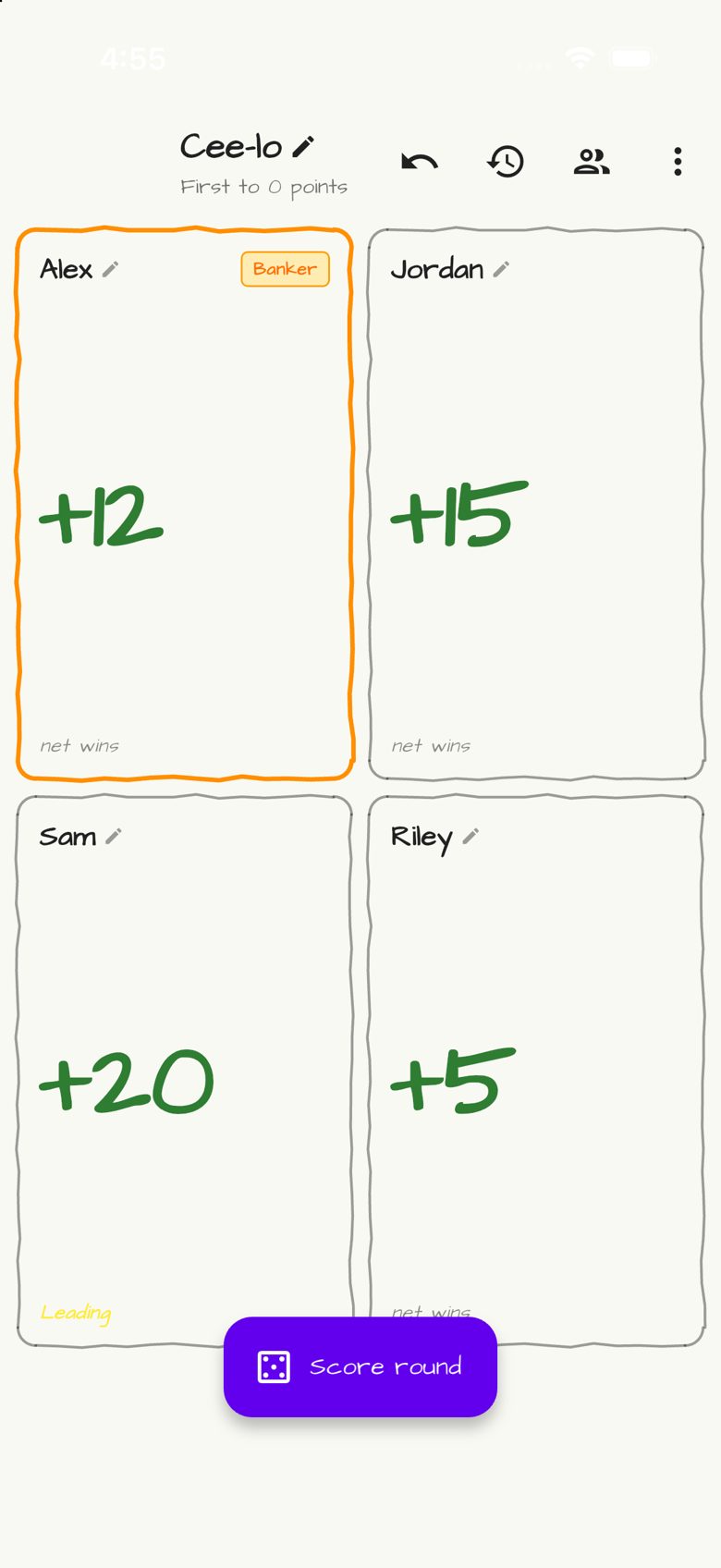
Cee-lo (4-5-6) has a dedicated scorecard in Doodle Score — everything is pre-configured including score tracking, validation, and special rules.
Download the app, tap New Scorecard, and choose Cee-lo (4-5-6).
Game Identity
- Name: Cee-lo (4-5-6)
- Player Count: 2–10 players. Standard: 3–6.
- Teams: No teams. All players compete individually per round (one player is "the banker").
- Theme: Street dice game of Chinese origin. Players bet against a banker, rolling 3 dice to establish a point or hit an instant result.
Scoring Mechanics
- Scoring Variant: Special — round-based win/loss tracking. Players accumulate wins and losses against the banker each round.
- Target Score: No fixed score target. Play for an agreed number of rounds or until players agree to stop.
- Unit of Scoring: Round wins (+1) and losses (−1) per player vs. banker.
- Lower vs. Higher: Most wins (net positive) wins the session.
Rules & Validation
Turn Structure
One player is the Banker (rotates each round).
All other players roll against the banker.
Possible Outcomes (rolled by any player):
Roll Result 4-5-6 Instant win (Cee-lo) Triple (any three of a kind) Instant win 1-2-3 Instant loss Pair + different die Point is the different die (1–6) No qualifying result Re-roll (up to 3 times) Point Comparison: If both banker and player establish a point, higher point wins. Ties favor the banker.
Banker Procedure:
- Banker rolls first to establish their result.
- Each challenger rolls against the banker's result.
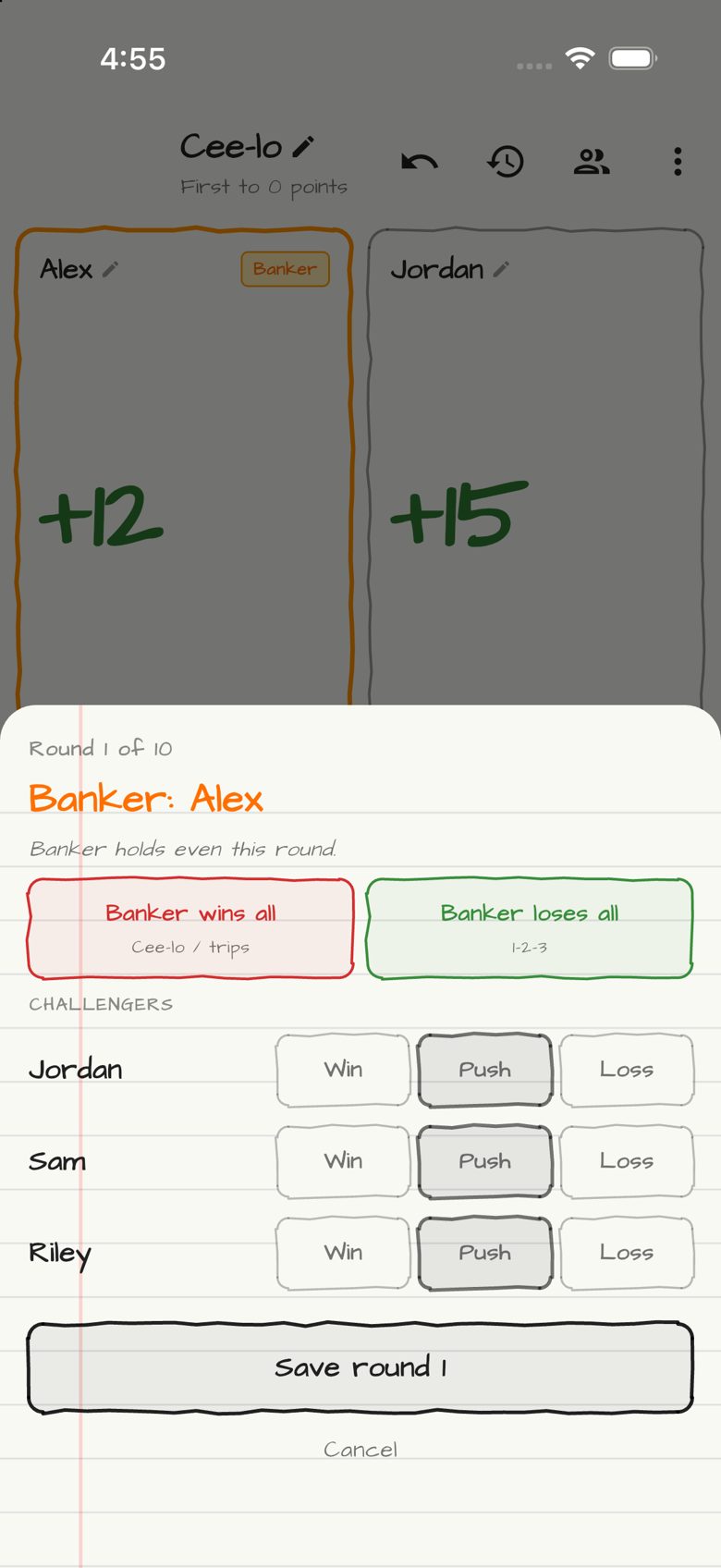
- If banker rolls an instant win, all challengers lose. If instant loss, all win.
Validation Rules
- Each round, record each player's result as Win (+1), Loss (−1), or Push (0).
- Banker rotation: typically moves clockwise each round.
Special Actions / Bonuses
- Cee-lo (4-5-6): Instant win regardless of banker's roll.
- 1-2-3: Instant loss regardless of banker's roll.
- Trips: Three of a kind — instant win (trips of 6 is highest, trips of 1 is lowest but still wins).
Win Conditions
- Condition: After the agreed number of rounds, the player with the highest net score (wins minus losses) wins the session.
- Tie-Breaker: Tied players roll one final head-to-head; highest point wins.
Common Cee-lo (4-5-6) rules questions
The arguments that come up at the table, answered from the official rules. Where house rules differ, we say so.
Is 4-5-6 better than trips in Cee-lo?
Yes. 4-5-6 is the best roll, then trips from 6s down, then points from 6 down. 1-2-3 is an automatic loss.
Who wins a tie in Cee-lo?
In banker games, ties usually go to the banker.
House rule Some groups re-roll ties instead.
What if you roll nothing?
A roll with no pair, trips, 4-5-6 or 1-2-3 doesn't count, so roll again.
How many times can you re-roll?
You keep rolling until you get a result that counts.
House rule Some groups cap it at three tries.
As an Amazon Associate, Doodle Score earns from qualifying purchases.